Our Process
At the heart of EdReports is a commitment to a by educator, for educator instructional materials review process. Educators design our review rubrics. Educators meet over several months to examine materials, gather evidence, and come to consensus on scoring recommendations. Educators are leading the way to support teachers with the tools and resources they need to ensure all students are college and career-ready.
There are two ways to learn more about EdReports' review process
1. Watch the video
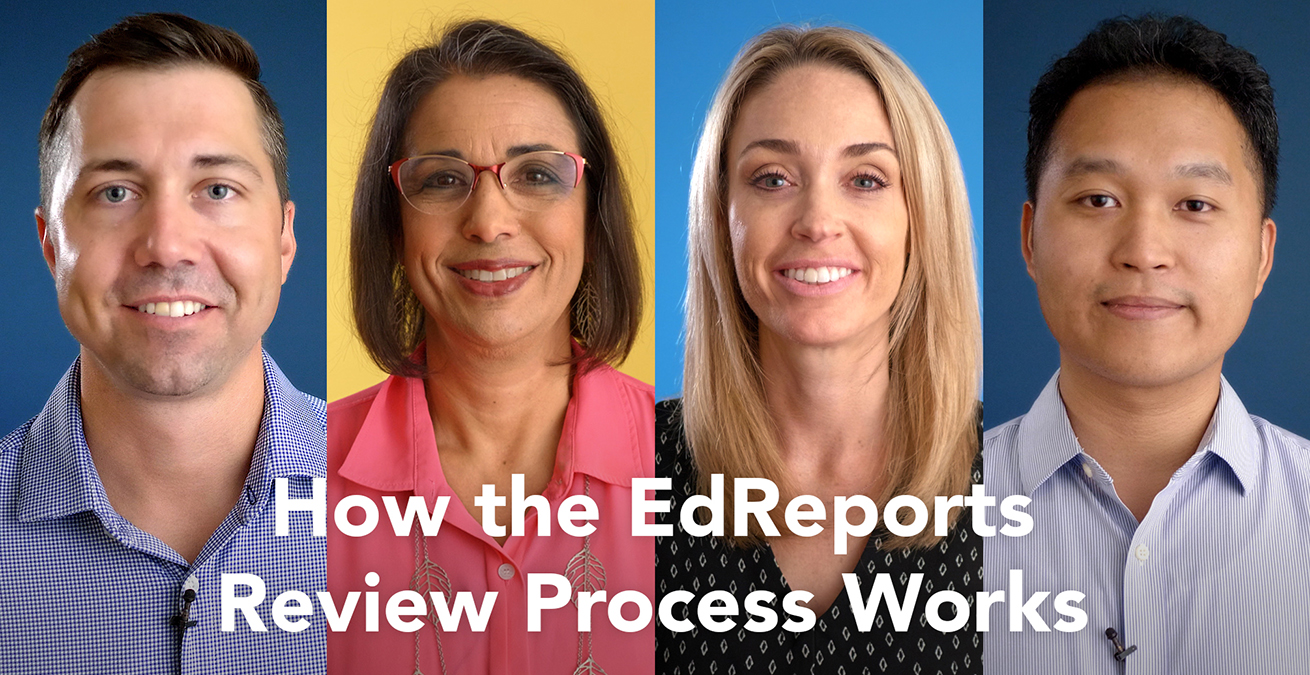
2. Continue on to the next page to follow our interactive infographic

Our Process
Educator-led teams develop rubrics and evidence guides

Listen & Investigate
Educator development teams delve into an extensive research base, examine existing rubrics from the field, and consider the criteria that are most important to those who use instructional materials in their classroom every day: teachers. The team also absorbs the findings from a national learning tour of content experts and educators.

Collaborate
With a focus on the standards and the instructional shifts, educator teams assess current rubrics, collect feedback, and develop content-specific rubrics and evidence guides for the EdReports review processes.

Create & Continuously Improve
With input from experts in the field, including teacher membership organizations, state departments of education, school districts, researchers and leading policy voices, we revise and improve rubrics and evidence guides. As a learning organization, we continuously strive to incorporate feedback from the field and strengthen our review criteria and processes.
Our Process
Recruit and train reviewers
Our network of 600+ reviewers receive virtual and face-to-face professional learning on the standards and shifts as well as the EdReports review rubric and process.
Reviewers go through a rigorous selection process.
Collectively, our reviewers bring thousands of years of experience.
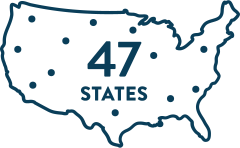
Reviewers are from diverse groups spanning 47 states.
Our Process
Educator-led teams conduct rigorous reviews

Gathering Evidence
Reviews focus on gathering evidence about the presence of standards, how well the standards are sequenced, the depth with which standards are included, and other important characteristics of high-quality instructional materials. Educator teams discuss their individual findings for each indicator at weekly team meetings.

Reaching Consensus
Throughout the weekly meetings, educators work together to reach consensus on the score and supporting evidence to be included in the final report.

Breadth & Depth of Reviews
Reviews take between 4-6 months with individuals dedicating at least 5-10 hours per week to evaluate materials. Final reports are the result of multiple educators analyzing every page of the materials, calibrating all findings, and reaching a unified conclusion.
Our Process
Engage with publishers
We aim to work collaboratively with publishers throughout the review process.
Identifying Materials:
EdReports identifies the core set of materials and purchases all materials directly from the publisher of the program.
Orientation and Clarifying Questions:
- All publishers are invited to provide an hour-long orientation to the review team so that educators have full understanding of the design of the materials.
- The review teams have the opportunity through EdReports to ask the publisher clarifying questions about the program.
Counterevidence:
Publishers receive an embargoed, draft copy of the initial report and can provide counterevidence to EdReports' findings that will be brought back to the review team for consideration.
Publisher Response:
Publishers may also post two sets of information on the EdReports website once the review is published: a response to the educator report and a document that includes any relevant background information or research on the instructional materials.
Our Process
Release evidence-rich, independently reviewed reports to the field
Free
All reports are free to the public.
Empowering Educators
Information empowers educators and districts to seek, identify, and demand high-quality instructional materials so that students at all levels are prepared for college and career.

High Quality Materials
Transparency impacts the materials market by increasing the demand for quality materials. As a result, materials continue to improve for the benefit of teachers and students.
#MaterialsMatter
EdReports' mission is to increase the capacity of teachers, administrators, and leaders to seek, identify, and demand the highest quality instructional materials. Explore hundreds of free reports and learn more about why materials matter for students and their futures.
Interested in becoming a reviewer? Learn more about this great opportunity to improve education for all students while networking with expert educators from across the country.
Email Sign-Up
Be the first to know when we release new reports, resources, and guidance on how to select quality instructional materials for your community.